Art, Environment and the Creative Path
Art Journal Project, DG Creative Wellbeing — Liz McQueen
Dumfries and Galloway is one of the most sparsely populated regions in Scotland — 22 people per square kilometre, a median age of 51, nearly eleven years above the UK average. The region faces the dual challenge of a falling population and an ageing one, with fewer working-age residents and growing pressure on health and community services. At nearly 2,500 square miles, it takes over two hours to cross from east to west. A Crichton Institute survey found that over 20% of households have no access to private transport — around 30,000 people at risk of being cut off from the cultural and social life of the region.[1] Where isolation deepens and community life thins, people feel less attached to where they live — and less likely to stay.[2] But where belonging is actively built, communities become more resilient.
The region has something that works against that tide: a strong sense of community spirit and a deep attachment to place. Research by Dumfries and Galloway Council consistently identifies belonging as one of its most significant assets — a deep attachment to a place that is genuinely distinctive: dark skies and UNESCO Biosphere wetlands, Southern Upland hills and over two hundred miles of coastline, ancient forest and migratory birds on the Solway shore. And under pressure in ways that make the relationship between people and place more urgent, not less. Sitka spruce plantations cover significant stretches of hillside across Scotland, making up 43% of its woodlands according to Scottish Forestry data — more than triple the coverage of native Scots pine — and Dumfries and Galloway is no exception.[3] NatureScot has found negative impacts on protected bogland and heathland, with habitats under threat, native species in decline, and increasing pressure from development.[4] The relationship between people and their landscape here is both a wellbeing question and an environmental one.
I lead the Art Journal Project as Adult Creative Wellbeing Lead at OutPost Arts. The project is one strand of DG Creative Wellbeing — a groundbreaking programme of arts activities and interventions across Dumfries and Galloway, working in community, residential care and healthcare settings. What follows is grounded in three years of working with adults in the community across the region — and what I observed when people were given time, materials and permission to make.
The project began in the spring of 2020. OutPost Arts was founded in Langholm — a mill town on the River Esk, surrounded by hills and woodland. Our pilot Art Journal Project was a direct response to pandemic isolation for people in the local community. Community life had stopped overnight. In Scotland, daily exercise meant a thirty-minute mental health walk within five miles of home. Lucy Bell, Creative Director of OutPost Arts, secured funding, materials were left on doorsteps, and sessions were recorded as YouTube videos. Participants began making work remotely, each with the same materials, starting exactly where they were.
When the programme expanded across the whole of Dumfries and Galloway in 2023, the question I kept returning to was: how do you make this feel genuinely rooted in place? Not a generic project, but creative wellbeing informed by the specific landscapes and seasons of Dumfries and Galloway.
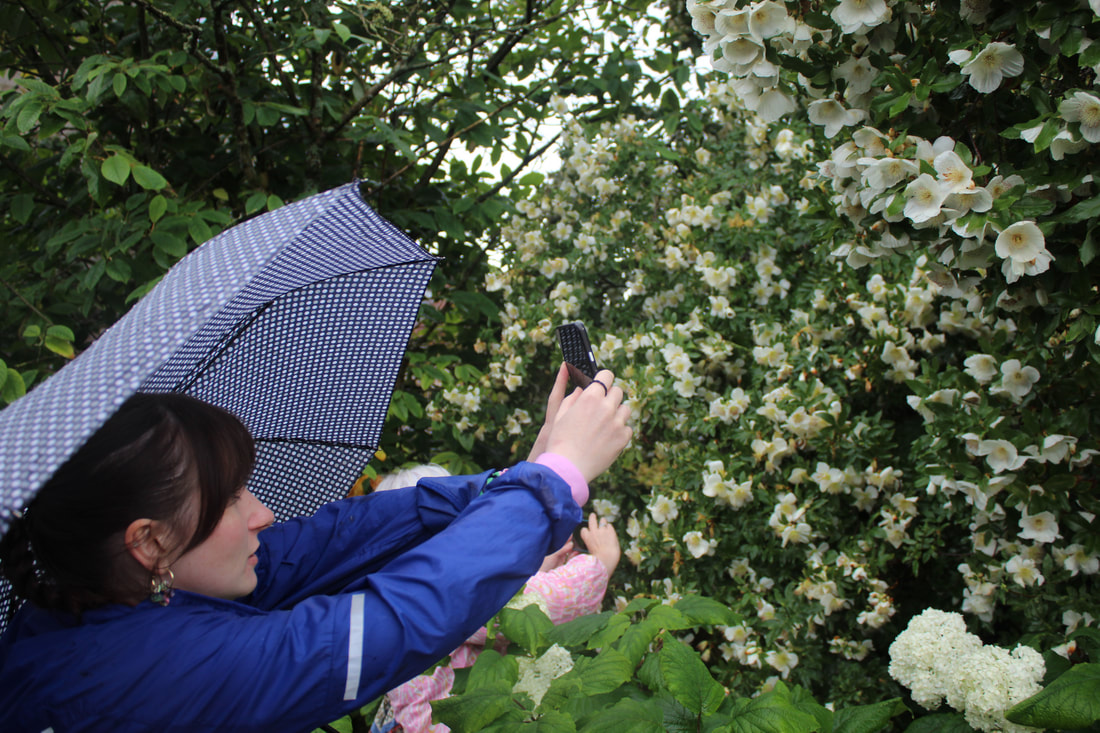
Richardson and Sheffield’s 2017 research at the University of Derby found that noticing three good things in nature each day produces sustained increases in wellbeing — and, crucially, in pro-nature behaviour.[5] Not grand gestures or specialist knowledge, just attention. In spring in Dumfries and Galloway, that might be snowdrops at the edge of a field or a bluebell wood coming into colour, tadpoles in a puddle or the first swallows back, migratory geese on the Solway and lambs in the fields. For a participant in Stranraer it might be shells on the shore, for someone in Dumfries blossom at the Crichton. No matter where participants were across the region — coast, town or upland — there was something of this landscape within reach. The project gave that noticing a creative frame.
Sessions began with pencil, paper and a blank page — the simplest possible starting point. Eyes closed, then open, pen or charcoal moving across the page, responding to sensation before thinking. Research by Andrade (2010) found that doodling improves memory recall by 29% and aids concentration,[6] while Kaimal et al. (2017) showed it activates the brain’s reward pathways and increases blood flow to the prefrontal cortex — the area governing thoughts, feelings and actions.[7] From there, session one moved to a continuous line drawing — pen never leaving the page — drawing whatever plant or view was immediately to hand. A crow on a chimney pot, a vase of tulips on a windowsill, a favourite tree, the view from the kitchen sink. Not as a finished artwork, but as an act of really looking — slowly, carefully — at what was actually there.
That noticing ran through many sessions, each one led by a specialist artist working in a different medium. Textile artist Helen Walsh brought her knowledge of native birds for collage work rooted in the wildlife of this region. Botanical gelli printing with Julie Stephen used leaves and petals pressed directly into ink. Working with ceramicist Jackie Zehnder, participants pressed ferns into clay to make vessels carrying the texture of this place. Ed and Lucy Campbell of Old Mill Arts brought natural pigments and earth colours — the specific palette of DG, made from it, handed back to the people who live here.
Dumfries and Galloway is one of the most sparsely populated regions in Scotland — 22 people per square kilometre, a median age of 51, nearly eleven years above the UK average. The region faces the dual challenge of a falling population and an ageing one, with fewer working-age residents and growing pressure on health and community services. At nearly 2,500 square miles, it takes over two hours to cross from east to west. A Crichton Institute survey found that over 20% of households have no access to private transport — around 30,000 people at risk of being cut off from the cultural and social life of the region.[1] Where isolation deepens and community life thins, people feel less attached to where they live — and less likely to stay.[2] But where belonging is actively built, communities become more resilient.
The region has something that works against that tide: a strong sense of community spirit and a deep attachment to place. Research by Dumfries and Galloway Council consistently identifies belonging as one of its most significant assets — a deep attachment to a place that is genuinely distinctive: dark skies and UNESCO Biosphere wetlands, Southern Upland hills and over two hundred miles of coastline, ancient forest and migratory birds on the Solway shore. And under pressure in ways that make the relationship between people and place more urgent, not less. Sitka spruce plantations cover significant stretches of hillside across Scotland, making up 43% of its woodlands according to Scottish Forestry data — more than triple the coverage of native Scots pine — and Dumfries and Galloway is no exception.[3] NatureScot has found negative impacts on protected bogland and heathland, with habitats under threat, native species in decline, and increasing pressure from development.[4] The relationship between people and their landscape here is both a wellbeing question and an environmental one.
I lead the Art Journal Project as Adult Creative Wellbeing Lead at OutPost Arts. The project is one strand of DG Creative Wellbeing — a groundbreaking programme of arts activities and interventions across Dumfries and Galloway, working in community, residential care and healthcare settings. What follows is grounded in three years of working with adults in the community across the region — and what I observed when people were given time, materials and permission to make.
The project began in the spring of 2020. OutPost Arts was founded in Langholm — a mill town on the River Esk, surrounded by hills and woodland. Our pilot Art Journal Project was a direct response to pandemic isolation for people in the local community. Community life had stopped overnight. In Scotland, daily exercise meant a thirty-minute mental health walk within five miles of home. Lucy Bell, Creative Director of OutPost Arts, secured funding, materials were left on doorsteps, and sessions were recorded as YouTube videos. Participants began making work remotely, each with the same materials, starting exactly where they were.
When the programme expanded across the whole of Dumfries and Galloway in 2023, the question I kept returning to was: how do you make this feel genuinely rooted in place? Not a generic project, but creative wellbeing informed by the specific landscapes and seasons of Dumfries and Galloway.
Richardson and Sheffield’s 2017 research at the University of Derby found that noticing three good things in nature each day produces sustained increases in wellbeing — and, crucially, in pro-nature behaviour.[5] Not grand gestures or specialist knowledge, just attention. In spring in Dumfries and Galloway, that might be snowdrops at the edge of a field or a bluebell wood coming into colour, tadpoles in a puddle or the first swallows back, migratory geese on the Solway and lambs in the fields. For a participant in Stranraer it might be shells on the shore, for someone in Dumfries blossom at the Crichton. No matter where participants were across the region — coast, town or upland — there was something of this landscape within reach. The project gave that noticing a creative frame.
Sessions began with pencil, paper and a blank page — the simplest possible starting point. Eyes closed, then open, pen or charcoal moving across the page, responding to sensation before thinking. Research by Andrade (2010) found that doodling improves memory recall by 29% and aids concentration,[6] while Kaimal et al. (2017) showed it activates the brain’s reward pathways and increases blood flow to the prefrontal cortex — the area governing thoughts, feelings and actions.[7] From there, session one moved to a continuous line drawing — pen never leaving the page — drawing whatever plant or view was immediately to hand. A crow on a chimney pot, a vase of tulips on a windowsill, a favourite tree, the view from the kitchen sink. Not as a finished artwork, but as an act of really looking — slowly, carefully — at what was actually there.
That noticing ran through many sessions, each one led by a specialist artist working in a different medium. Textile artist Helen Walsh brought her knowledge of native birds for collage work rooted in the wildlife of this region. Botanical gelli printing with Julie Stephen used leaves and petals pressed directly into ink. Working with ceramicist Jackie Zehnder, participants pressed ferns into clay to make vessels carrying the texture of this place. Ed and Lucy Campbell of Old Mill Arts brought natural pigments and earth colours — the specific palette of DG, made from it, handed back to the people who live here.
In September 2025, participants gathered at Old School Thornhill for a session with Old Mill Arts. Working with handmade watercolours, inks and pigments sourced from across Dumfries and Galloway, each person chose a symbol that resonated with them. They applied these to handmade paper originally created as a garden installation by Alison Fair-Bixler, its fibres carrying traces of rose petals and lavender. Abstract forms were then woven in from Merrick Scottish Blackface wool (hand-dyed in hawthorn, woad and weld from the Galloway and Southern Ayrshire UNESCO Biosphere), connecting the individual marks into a collective whole. The result — Collective Ground — was a single piece that could only have come from here: individual voices, collective making, materials drawn entirely from this landscape.
That work was shown at Press Play, the Art Journal Project and Creative Toolbox end of year exhibition at Midsteeple Quarter in Dumfries, as part of the Scottish Mental Health Arts Festival. Displayed in a town centre space, it carried something of the journey outward — from individual mark to collective voice.
The neuroscientist Kelly Lambert identified the effort-driven rewards circuit — the neurological system activated most powerfully when we work with our hands to make something tangible.[8] Three years of the project bore this out. As one 2025 participant put it: “When my mental health is shaky, I feel ‘invisible’ and making marks on paper has helped me to find the visible and emotional part of myself.” Participants who arrived uncertain, who had never made anything since school, gradually built a practice. As sketchbooks filled their confidence grew.
Research by Holt-Lunstad et al. found that the health risks of social isolation are comparable to smoking fifteen cigarettes a day — exceeding those of physical inactivity or obesity.[9] The Art Journal Project could not solve rural isolation. But it created the conditions for something valuable: participants who had never met, spread across Dumfries and Galloway, formed their own community through a shared creative practice.
What the sketchbooks documented is what Richardson’s research supports: that the more closely people look at a place, the more they come to care for it. Acquaintance can become attachment, and that care can become connection — to place, to each other, to the act of making. That is the hope.
The ideas explored here underpin our work going forward. What started as a response to Covid continues. The Art Journal Project’s sister programme Creative Toolbox, working with young people, is currently collaborating with Species on the Edge as part of their Graduate Project, beginning with a walk at RSPB Mersehead — young people learning to notice what is there, and what is at risk. The natural environment of DG — its species, habitats and landscapes — is both the inspiration and the subject of their work.
Land artist Jim Buchanan’s spiral paths — mown into the Crichton meadow as a commissioned work for this event — offer their own invitation: to walk, to notice, to engage with the landscape. Similar ideas are at the heart of the Art Journal Project. If you are able, take time to walk them today. Jim will speak about the work in his spotlight session.
Creative wellbeing rooted in this landscape is both supporting the people who live here and quietly building the relationship between people and place that makes communities resilient. The learning from this work is distilled in OutPost Arts’ Manifesto for Creative Wellbeing in Dumfries and Galloway — an evidence-based foundation for future action, and an agenda for change.
[1]The Crichton Institute, cited in Dumfries and Galloway Council Transport Strategy documentation (c.2015).
[2]Dumfries and Galloway Council, Depopulation Report (March 2026). Available at: dumfriesgalloway.moderngov.co.uk
[3]Scottish Forestry, Scotland’s Forests and Woodlands (2023). Available at: forestry.gov.scot
[4]NatureScot, Plantation on Ancient Woodland Sites (PAWS) Restoration. Available at: nature.scot
[5]Richardson, M., & Sheffield, D. (2017). Three good things in nature: Noticing nearby nature brings sustained increases in connection with nature. PsyEcology, 8(1), 1–32. https://doi.org/10.1080/21711976.2016.1267136
[6]Lambert, K. (2008). Lifting Depression: A Neuroscientist’s Hands-On Approach to Activating Your Brain’s Healing Power. New York: Basic Books.
[7]Andrade, J. (2010). What does doodling do? Applied Cognitive Psychology, 24(1), 100–106.
[8]Kaimal, G., Ray, K., & Muniz, J. (2016). Reduction of cortisol levels and participants’ responses following art making. Art Therapy, 33(2), 74–80.
[9]Holt-Lunstad, J., Smith, T. B., Baker, M., Harris, T., & Stephenson, D. (2015). Loneliness and social isolation as risk factors for mortality. Perspectives on Psychological Science, 10(2), 227–237.
That work was shown at Press Play, the Art Journal Project and Creative Toolbox end of year exhibition at Midsteeple Quarter in Dumfries, as part of the Scottish Mental Health Arts Festival. Displayed in a town centre space, it carried something of the journey outward — from individual mark to collective voice.
The neuroscientist Kelly Lambert identified the effort-driven rewards circuit — the neurological system activated most powerfully when we work with our hands to make something tangible.[8] Three years of the project bore this out. As one 2025 participant put it: “When my mental health is shaky, I feel ‘invisible’ and making marks on paper has helped me to find the visible and emotional part of myself.” Participants who arrived uncertain, who had never made anything since school, gradually built a practice. As sketchbooks filled their confidence grew.
Research by Holt-Lunstad et al. found that the health risks of social isolation are comparable to smoking fifteen cigarettes a day — exceeding those of physical inactivity or obesity.[9] The Art Journal Project could not solve rural isolation. But it created the conditions for something valuable: participants who had never met, spread across Dumfries and Galloway, formed their own community through a shared creative practice.
What the sketchbooks documented is what Richardson’s research supports: that the more closely people look at a place, the more they come to care for it. Acquaintance can become attachment, and that care can become connection — to place, to each other, to the act of making. That is the hope.
The ideas explored here underpin our work going forward. What started as a response to Covid continues. The Art Journal Project’s sister programme Creative Toolbox, working with young people, is currently collaborating with Species on the Edge as part of their Graduate Project, beginning with a walk at RSPB Mersehead — young people learning to notice what is there, and what is at risk. The natural environment of DG — its species, habitats and landscapes — is both the inspiration and the subject of their work.
Land artist Jim Buchanan’s spiral paths — mown into the Crichton meadow as a commissioned work for this event — offer their own invitation: to walk, to notice, to engage with the landscape. Similar ideas are at the heart of the Art Journal Project. If you are able, take time to walk them today. Jim will speak about the work in his spotlight session.
Creative wellbeing rooted in this landscape is both supporting the people who live here and quietly building the relationship between people and place that makes communities resilient. The learning from this work is distilled in OutPost Arts’ Manifesto for Creative Wellbeing in Dumfries and Galloway — an evidence-based foundation for future action, and an agenda for change.
[1]The Crichton Institute, cited in Dumfries and Galloway Council Transport Strategy documentation (c.2015).
[2]Dumfries and Galloway Council, Depopulation Report (March 2026). Available at: dumfriesgalloway.moderngov.co.uk
[3]Scottish Forestry, Scotland’s Forests and Woodlands (2023). Available at: forestry.gov.scot
[4]NatureScot, Plantation on Ancient Woodland Sites (PAWS) Restoration. Available at: nature.scot
[5]Richardson, M., & Sheffield, D. (2017). Three good things in nature: Noticing nearby nature brings sustained increases in connection with nature. PsyEcology, 8(1), 1–32. https://doi.org/10.1080/21711976.2016.1267136
[6]Lambert, K. (2008). Lifting Depression: A Neuroscientist’s Hands-On Approach to Activating Your Brain’s Healing Power. New York: Basic Books.
[7]Andrade, J. (2010). What does doodling do? Applied Cognitive Psychology, 24(1), 100–106.
[8]Kaimal, G., Ray, K., & Muniz, J. (2016). Reduction of cortisol levels and participants’ responses following art making. Art Therapy, 33(2), 74–80.
[9]Holt-Lunstad, J., Smith, T. B., Baker, M., Harris, T., & Stephenson, D. (2015). Loneliness and social isolation as risk factors for mortality. Perspectives on Psychological Science, 10(2), 227–237.